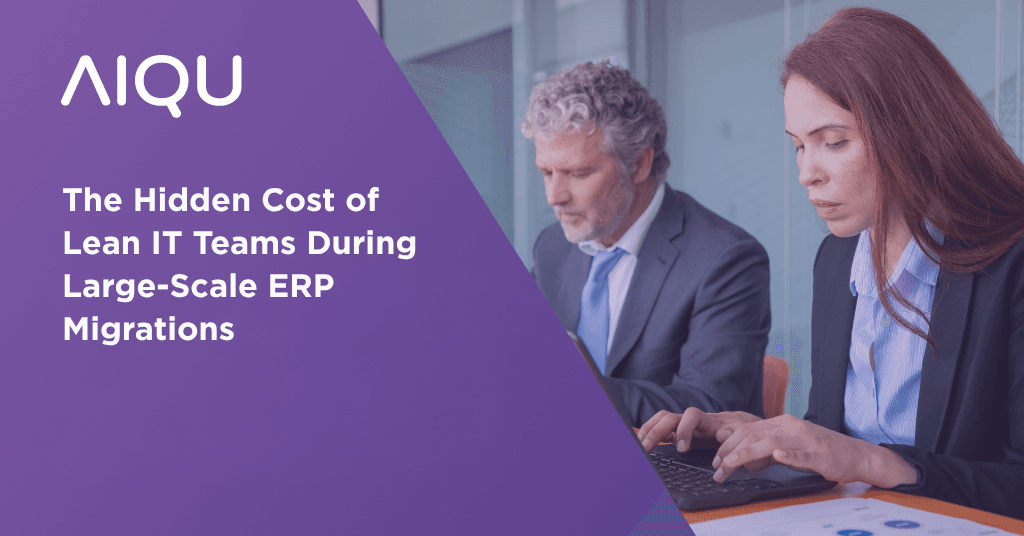
The Hidden Cost of Lean IT Teams During Large-Scale ERP Migrations
It is one of the main types of technology upgrades that you could make in a company to move from one Enterprise Resource Planning (ERP) system to another. The new system will unify your finance, supply chain, human resources, and operations all on one single platform.
In order to keep costs as low as possible, company executives often try to complete such projects with the small internal IT team they already have. From a theoretical point of view, it does look like a great idea to lower costs, and yet the practical side is a different story. Usually, assigning a small team the responsibility to handle an enterprise migration project results in hidden costs, serious burnouts, and long delays in project completion time.
Below are the genuine financial costs of a lean IT team managing the company during an ERP launch, together with several ways to prevent them.
1. Day-to-Day Activities Slow Down
Your IT team members end up working on configurations, data cleanup, and taking part in migration meetings during the day, and their fundamental daily work activities get neglected. That is because the team members are spending so much time on the ERP project tasks that their core job responsibilities are getting left out.
Delaying system updates becomes the norm, employee support requests queue up, and network security assessments are skipped. When daily operations are slowed down, the entire company loses productivity. The money saved by having the team in-house is eaten away very rapidly by this loss in productivity.
2. Extreme Employee Exhaustion and Leaving the Company
Migrations like that of enterprises are very demanding and often lead to long working hours. Eventually, even a few team members can only carry an intense workload for so long, so burnout is bound to happen. As a result, you run the risk of some of the top IT professionals leaving the company mid-project. It is catastrophic to have important staff members leave an enterprise rollout midway:
- Key knowledge of the project is taken away by these individuals.
- Hiring a new skillful IT person is expensive.
- The rest of the team becomes even more burdened.
3. High Costs from Avoidable Errors
Since ERP implementations are quite extensive, an effective data cleansing, flowcharting, and custom development should be performed with great care using advanced software engineering methods.
Only a handful of employees, working in-house, will rarely have sufficient practical background in state-of-the-art systems for large-scale enterprises. When they are under pressure and stressed, they tend to make costly errors.
- Copying or importing dirty or duplicate legacy data;
- Defining the system access roles too weak;
- Developing the business process customizations that are not optimal.
As a rule, once the system has gone live, any mistakes must be corrected, resulting in higher costs than setting up the system correctly in the first place.
4. Delays and the Exceeding of Budget
Every single month that the migration period lasts, expenses rise dramatically. Besides the prolongation of the vendor’s contract, you will also have to pay for the additional software licenses and delay the financial reward of the new platform.
Lean IT teams can easily be overloaded by unplanned technical hiccups. When there are no extra hands to deal with the problems of system breakdowns at hand, project timelines may run over, and thus you transform your six-month implementation plan into an annual one.
Typical ERP Implementation Issues
Upgrading an entire ERP system with a small team presents several specific challenges.
- A big data challenge: Most of the time, the small IT team is not given enough man-hours or time to thoroughly clean old records. The consequences are wrong data analysis and low adoption rates right after the system is available to be used.
- Difficulties with API Programming: The in-house personnel are compelled to create all sorts of complicated system interfaces themselves. The result can be crashes, the malfunctioning of add-ins, or the total breakdown of external tools that depend on the system.
- No Change Management at all: The entire attention is paid solely to the work of setting up the system; thus, the change management side is totally left to the background. The consequence is that little time is devoted to instructing employees from the different departments on the workings of the software so a large part of the workforce is resistant to this new way of working.
Turning to the right ERP migration experts will make available the additional human, technical, or other support required in order to handle the most critical ERP implementation issues effectively and, therefore, prevent them from holding back your company’s success.
How to Protect Your Team and Your Budget
Expanding your permanent workforce is not the solution to achieving success. Rather, hire the experts to deal with the more complicated aspects of the technical work. This strategy enables your inside team to concentrate on business logic, internal security, and day-to-day assistance.
Get AIQU to Support You on a Smooth Enterprise Expansion
A major software changeover without exhausting your internal manpower demands the right kind of staffing. AIQU is the perfect partner for companies needing top tech professionals, niche talent, or temporary hires to get the job done. We are here to support the project with whatever is needed-expert data engineers, ERP specialists, and temporary technical help to keep your daily operations running smoothly. AIQU quickly connects you with experienced professionals, allowing you to evaluate their work before hiring. Let your scarce resources not hold back your company’s digital transformation. Go to AIQU today to find out how we use recruitment and IT staffing in the way you specifically need to keep your migration project on course and within the budget.
Frequently Asked Questions
1. What’s the worst business mistake that companies make when moving to a new ERP system?
One common mistake is underestimating how difficult and time-consuming such a switch will be. Another mistake is relying entirely on the internal IT department while expecting it to continue handling its regular responsibilities.
2. How does a lean IT team impact overall system adoption?
When the lean team is exhausted and overworked, they often bypass the detailed training of end-users and change management, resulting in low employee adoption and dissatisfaction post-launch.
3. Why are specialized ERP migration services necessary?
A specialized ERP migration team provides proven tools, migration software, and deep platform expertise. Together, these help speed up implementation and reduce the risk of costly mistakes.
4. What are the most common ERP implementation challenges?
The biggest challenges include poor data quality, complex system integration, scope creep, budget overruns, and insufficient end-user training.
5. What do companies do to avert IT burnout from getting worse?
It is advisable for companies to avert burnout that way by outsourcing specialty migration work either through contractual staff or external consultants so that the internal team can be fully dedicated to core activities.