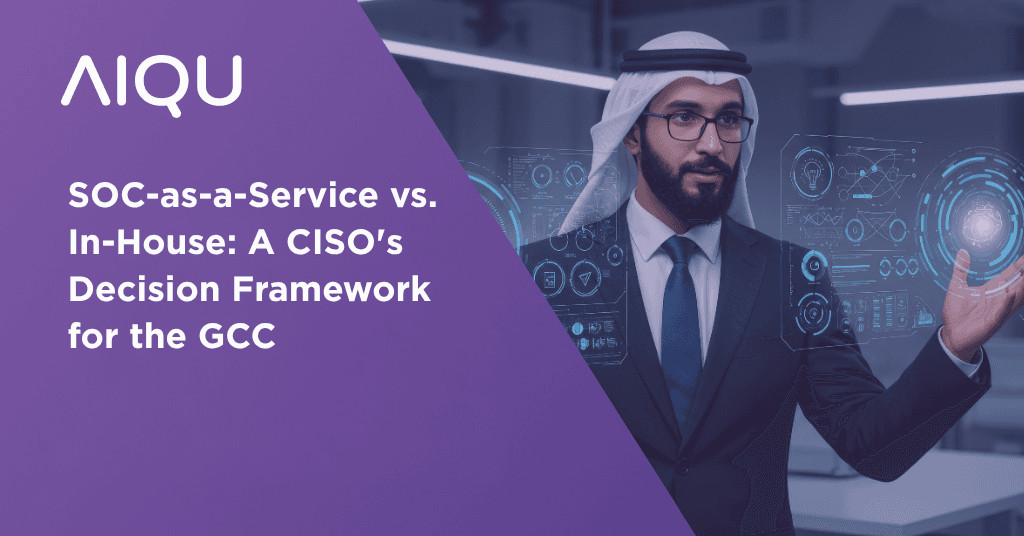
SOC-as-a-Service vs. In-House: A CISO’s Decision Framework for the GCC
Chief Information Security Officers (CISOs) in the Gulf Cooperation Council (GCC) region are tasked with an increasingly challenging mandate. With rising cybercrime fueled by rapid digitalization and smart city initiatives, while at the same time government regulations such as NCA ECC, SAMA CSF, and NESA impose strict cybersecurity requirements, maintaining 24/7 security monitoring has become a critical priority. At the same time, building an in-house Security Operations Center (SOC) is a time-, cost-, and resource-intensive endeavor requiring specialized headcounts that are difficult to find in the local market. When weighing the options between an in-sourced and outsourced SOC solution, CISOs across the UAE, Saudi Arabia, and the broader GCC region should consider the following four key decision-making factors.
The CISO Decision-Making Framework
1. The Real Cost: Capital vs Operational Costs
Establishing an in-house SOC requires a significant capital expenditure (CapEx) to purchase enterprise-grade security infrastructure and cybersecurity software (SIEM, SOAR, and EDR platforms). On the other hand, opting for a managed SOC (SOC as a service) model typically follows an operating expenditure (OpEx) approach since it involves subscribing to a third-party provider’s cybersecurity services. With the OpEx model, businesses can leverage enterprise-level cybersecurity infrastructure at a predictable monthly payment without incurring steep upfront costs.
2. Talent Acquisition and Retention Considerations
Another factor to consider when choosing between an in-sourced and outsourced SOC is talent availability and retention. With the cybersecurity professional shortage expected to reach 3.5 million, and with the scarcity of skilled workers even more acute in the Middle East, an in-house SOC presents a significant challenge in staffing and retention. To maintain round-the-clock network visibility and threat visibility, an in-house SOC would require hiring and retaining at least eight (8) security analysts on a 24/7 basis. In contrast, a SOC as a service model removes these challenges by providing businesses with immediate access to a team of seasoned cybersecurity experts who can monitor the company’s network 24/7.
3. Data Sovereignty and Local Regulations
A growing number of GCC governments are adopting data localization laws that require companies to store data on servers located within the country. As such, CISOs considering a SOC as a Service model should seek managed security service providers (MSSPs) that offer regional data residency options and comply with local regulations such as Saudi NCA, UAE TDRA, etc. By comparison, an in-house SOC affords the CISO full control and visibility over where the data is stored.
4. Time To Value and Threat Detection
The time it takes to establish an in-house SOC can be as long as 6 – 12 months, depending on the complexity of the organization’s SOC design and technology stack. During this time, the organization’s network is exposed to potential cyber threats. In contrast, a third-party MSSP can deploy a fully fledged SOC solution within a matter of weeks. Additionally, an experienced cybersecurity provider can assist the CISO in developing detection rules and playbooks specific to the organization’s cybersecurity strategy and threat landscape.
The CISO Decision Matrix
Ask yourself these three basic questions:
- Do you have the budget to hire 10+ internal analysts and buy costly software? If no, SOC as a Service is the logical path.
- Do you need 24/7 security monitoring right away to meet compliance deadlines? If yes, a managed provider gets you there much faster.
- Is your team overwhelmed by daily security alerts? If yes, outsourcing tier-1 alert filtering helps your internal team focus on business strategy.
Secure Your Organization with AIQU’s Expert SOC Services
When it comes to securing your enterprise across KSA, UAE, and the broader GCC region, speed, expertise, and compliance know-how are critical success factors. AIQU understands how to help enterprises across these regions achieve these objectives without breaking the bank. Our experience, technical expertise, and deep compliance know-how enable us to offer managed SOC services designed to support businesses’ security operations needs while helping them comply with local data sovereignty requirements. Our 24/7 threat detection and response capabilities, powered by world-class cybersecurity talent, help our clients stay ahead of the ever-evolving threat landscape. With over 800 technology professionals and 17+ years of industry experience, we strive to be your strategic cybersecurity partner. Contact AIQU today for a free consultation and elevate your enterprise security posture.
Frequently Asked Questions
1. What is SOC as a Service?
SOC as a Service is a subscription-based cybersecurity solution where organizations outsource their security operations center to a third-party provider. In this model, the provider monitors the client’s IT network 24/7 and takes appropriate action in the event of a cyberattack.
2. Will SOC as a Service be compliant with local regulations?
Yes, provided you choose a credible local provider. Reputable MSSPs typically structure their operations to align with local regulatory requirements, including NCA ECC, SAMA CSF, CBUAE, and the UAE’s PDPL.
3. Does SOC as a Service offer full visibility and control of the security operations center?
Yes, the client retains full control and visibility over the security infrastructure while the provider manages day-to-day operations.
4. Can small and medium enterprises (SMEs) afford SOC as a service?
Yes, in most cases, SOC as a service is more affordable than an in-house SOC, as it does not require a large CapEx.
5. How does a SOC provider respond to a confirmed cyberattack?
The SOC provider detects and responds to cyber threats in real time. In the case of a confirmed attack, the provider immediately isolates the affected systems and works with the client’s internal IT team to address the problem