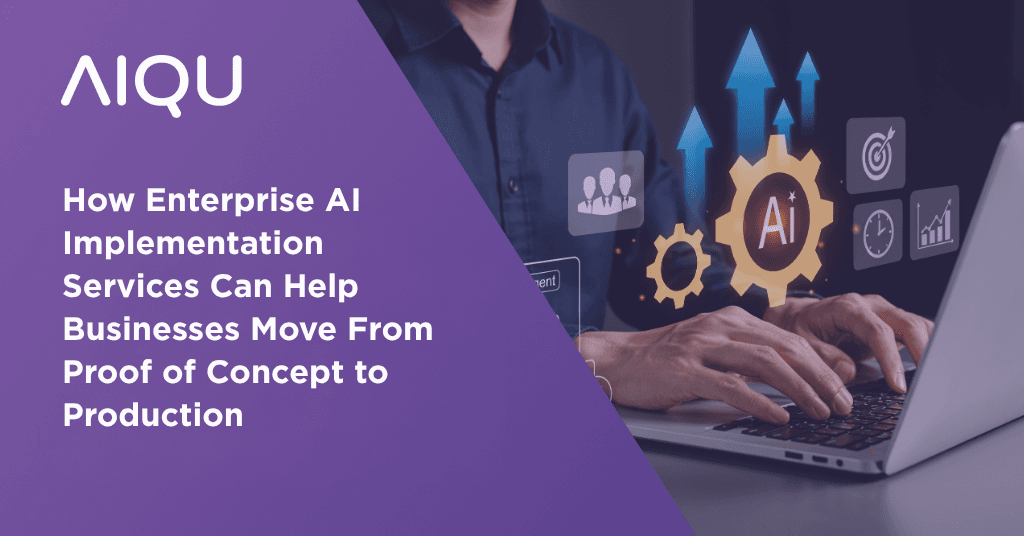
How Enterprise AI Implementation Services Can Help Businesses Move From Proof of Concept to Production
Developing an AI pilot is thrilling. You put together a team, collect a nice piece of data, create a model that would revolutionize the work of your organisation, and the management is pleased – you have successfully completed the Proof of Concept (POC).
However, after you reach that point, another challenge emerges, you need to take the pilot out of its controlled environment and bring it into the routine operations of your company. Here lies the problem that most enterprise AI projects face; making a leap from developing the AI to implementing it is far from straightforward. You need not only a good code but a whole infrastructure of the system and a way to make people use it.
That is precisely why more Organisations opt for hiring AI implementation services.
The Big Leap: Why AI Pilots Fail to Scale
In the GCC, many organisations are trapped in “pilot purgatory” and have successful AI POCs implemented within departments but fail to see value for the entire company. Why does that happen?
Firstly, there is the issue of data. For a pilot, a company uses data which is clean and static. On a production level, an AI solution would have to work with dynamic and inconsistent data coming from legacy systems, ERPs, and databases. Poor data governance means the AI solution would become degraded and inaccurate.
Secondly, there is the issue of infrastructure. An AI solution may run smoothly on a local server during the piloting stage, but in reality, it would break under company traffic. Proper scaling would require flexibility and strength of a cloud solution.
And last but not least, the human aspect should also be mentioned. A POC doesn’t test the reaction of employees to the implementation of AI. Without change management practices, no matter how good the solution is, it would never be used by employees.
What Are AI Implementation Services?
AI implementation services are professional consultation and technical assistance services offered to ensure safe deployment, management, and scalability of AI solutions. In contrast with software vendors, who simply provide you with a platform, implementation partners assist your company in integrating the technology into your unique business environment.
Implementation services embrace all aspects of deploying AI. It includes auditing the data infrastructure, creating the needed technical architecture for supporting the models, integration with your ERP and CRM solutions, as well as continuous support of the models in order to keep their predictions relevant.
How Implementation Partners Bridge the Gap
Transitioning from pilot projects to production stage involves a certain process. Implementation experts guide enterprises through it through focusing on three major spheres.
1. Data Integration and Governance
A quality of an AI model depends on data feeding it. Therefore, implementation experts assist businesses in breaking down data silos between various departments. Moreover, they develop automatic data pipelines that process live data before its input into an AI model. Additionally, they develop strict data governance policies in order to keep your enterprise information protected, comply with all the regulations, and be structured for machine learning.
2. Scalable Infrastructure Architecture
In order to survive in a production environment, AI requires significant computing power. Implementation partners assist CIOs and CTOs in creating cloud or hybrid-cloud architectures that can accommodate huge amounts of workload without affecting normal business operations. The goal is to make sure that the AI solutions are scalable and able to expand or shrink based on need, thereby reducing computing expenses.
3. Change Management and Training
All technology becomes useless if not used. One of the most important components of AI implementation services is change management. Partners assist business leaders in training employees, workflow redesign, and increasing trust in new technology. IT staff augmentation guarantees that you have the right people next to your team working on AI after deployment.
Proof of Concept vs. Production
This transition in needs is essential for technology leaders when implementing AI.
| Feature | Proof of Concept (POC) | Full-Scale Production |
| Data Source | Clean, static, and isolated data sets. | Messy, live data from multiple integrated systems. |
| Infrastructure | Minimal, often running on local or limited servers. | Robust, scalable cloud architecture with high availability. |
| User Base | A small group of technical testers and stakeholders. | The entire enterprise workforce and possibly end-customers. |
| Maintenance | None required once the test is finished. | Continuous monitoring for model drift and accuracy. |
| Business Value | Proves the idea is technically possible. | Generates measurable ROI, cuts costs, or drives revenue. |
Value for GCC Organisations
For Organisations operating within GCC, the use of AI goes beyond being a mere upgrade in operations. With the presence of ambitious strategies such as the Vision 2030 in Saudi Arabia and the UAE’s digitization efforts, Organisations in Riyadh, Dubai, and other places are forced to modernize quickly.
But while the speed at which digital transformation has been occurring in the Middle East has created many opportunities, it has also created another challenge – lack of specialised IT professionals. The implementation of AI can require very specialised talents that local Organisations might have trouble finding. Implementation services for AI help in bypassing this issue and in deploying AI solutions faster.
Collaborate With AIQUSearch For Implementing Your Vision Of AI
Efficiently implementing your project from a standalone pilot to full-fledged AI integration involves far more than merely possessing technology; it needs the expertise of the proper tech talent along with a strategic approach. AIQUSearch is a specialist in matching visionary Organisations located within the GCC with highly skilled IT professionals required for technical scaling and actualising the business’s growth. Whether your company needs to augment its workforce with IT staff or assistance in managing intricate AI and ERP integrations, our experts can help.
Frequently Asked Questions
1. How long does it take to implement an AI solution after piloting?
It depends on the complexity of the model and the status of your data currently. For simple deployment, it can take three to four months; for more complex implementations of AI across legacy ERP systems, it can take six to twelve months.
2. Is it necessary to improve all of our IT infrastructure before introducing AI?
It does not have to be like that. A reliable implementation partner will analyze your present infrastructure and find ways to introduce AI through cloud services and hybrid implementation, avoiding large initial investments in hardware.
3. What is model drift and how to avoid it?
This is a situation where an AI’s accuracy gradually decreases because the incoming data starts to differ from the training data. The implementation services provide tools that notify you when it is time to retrain the model.
4. How do implementation services secure the data?
Security is one of the key aspects of their work. Implementation providers make sure that strict data governance, encryption, and access management are in place to protect your enterprise data and comply with regional data protection regulations in the GCC.
5. Will AI replace the staff of our IT department?
No. AI will perform some automated operations, but enterprise AI maintenance still needs human management. Some implementation services also offer IT department augmentation by employing new employees