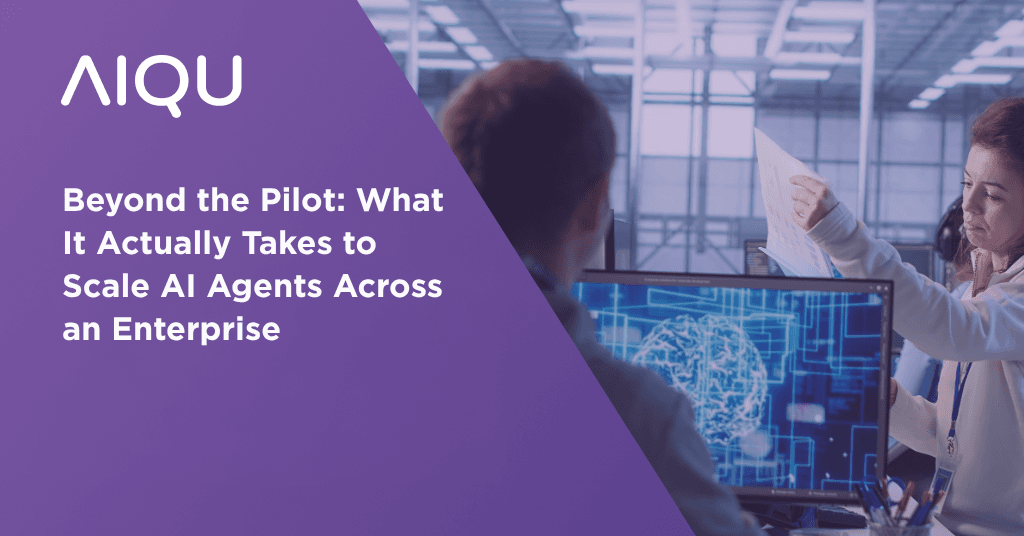
Beyond the Pilot: What It Actually Takes to Scale AI Agents Across an Enterprise
Most companies using AI started with small projects. Probably, you developed a chatbot that responds with predefined answers or made a tool that looks for internal company materials. Such initiatives are usually seen as a success if we limit ourselves to a small scale. People are thrilled; executives are excited after the presentation, and everybody declares AI is the way of the future.
Moving from a simple pilot to full-scale deployment is where most projects get stuck. Running enterprise AI agents across different departments, software tools, and business workflows requires much more than just good technology. Here is what it actually takes to make AI work at scale in a large organization.
1. Integrating AI with Your Current Systems
Most of the time, the demonstration project of a new technology is done in a test environment with a small amount of clean data. But in reality, data is scattered throughout all of the enterprise. Your customer relationship management (CRM) systems, enterprise resource planning (ERP) systems, cloud storage, and legacy systems all contain valuable data.
AI agents become useful only when they can access real-time data from multiple systems. For example, they should be able to access current inventory records, check a client’s status, or trigger actions in other applications. If an AI agent is not going to help with that, then it is nothing more than a smart search feature.
2. Setting Up Governance and Security Early
If five individuals use an evaluation tool, the security risks are minimal. When five thousand workers use the same tool, the level of risk goes up very rapidly.
You must figure out the critical security issues beforehand to avoid problems later:
- To prevent someone from accessing another person’s data, how do you manage it?
- How do you stop sensitive business information from falling into others’ hands?
- Is there a method to keep track of all AI-related decisions?
Top-level AI needs well-defined access controls, detailed logs of all activities, and very strict rules on compliance. Without proper safeguards, your team will not trust AI with critical business functions.
3. Helping the Team Deal with the Change
The technical reasons don’t usually account for delays; it’s usually people! Your employees may worry that AI will replace their jobs, making them hesitant to adopt it. Some may not even try new AI tools since they still prefer their own ways of doing things. So you have to make sure people understand the changes through clear explanations, provide hands-on training, and be there for them after training.
This is where working with specialized AI implementation services becomes valuable. The professionals will design the whole change process for you internally, and, by the end of the project, you will understand how to work hand in hand with your new colleague the AI assistant.
4. Thinking About Reliability, Not Just Speed
Suppose a pilot shows that an AI agent has a 5% error rate. It is likely to be ignored. A 5% error rate in a million transactions in a business setting could be financially and operationally devastating.
To scale AI effectively, you need:
- Mindful oversight is essential for the early detection of errors.
- Clear human involvement is needed for decision-making scenarios with serious consequences.
- We need feedback mechanisms regularly for the updating and retraining of models over time.
Scaling AI is not a one-time effort. It is the process in which you keep your eyes open for things to go wrong and keep correcting/improving them accordingly.
Transform Your Enterprise with AIQU
When one is talking about building AI that works really well in a few examples, that’s a very simple task, but when you are talking about running such AI across your entire company reliably, you need to find the right partner. AIQU’s role is to assist the companies in moving from pilot tests to more advanced custom, scalable AI platforms tailored for tangible results. If it’s about inserting AI tools into main business lines, modernizing previous applications, or implementing secure enterprise systems, our well-seasoned group of professionals will be there to support you throughout. No more testing, just start scaling. Get in touch at aiqusolutions.com to find out precisely how we can collaborate with you towards achieving your AI goals.
Frequently Asked Questions
1. What is the difference between a traditional chatbot and an AI agent?
Regular chatbots just give replies based on the input text. But AI agents can execute tasks, utilize software, perform multi-step instructions, and also finish business processes autonomously.
2. Why are the majority of AI pilot projects not scalable?
The reason many pilot projects fail to expand beyond initial stages is the insufficient integration with core business software, resistance from employees, or lack of necessary security and data management policies.
3. Should we discard our existing software to make a place for AI agents?
Full enterprise rollout usually lasts from 3 to 9 months depending on the company scale and the complexity of previously installed systems.
4. Should we discard our existing software to make a place for AI agents?
Absolutely not. As a matter of fact, the newest AI software has all features to access your existing programs, software, and utilities through the APIs and specific connectors to be implemented.
5. How can you measure the ROI of AI agents?
By monitoring the reduction of time spent doing tasks by hand, the decrease in the occurrence and severity of process mishaps, the quicker turnaround of customer support, and the general performance of a team are getting better, so the results can be quantified.