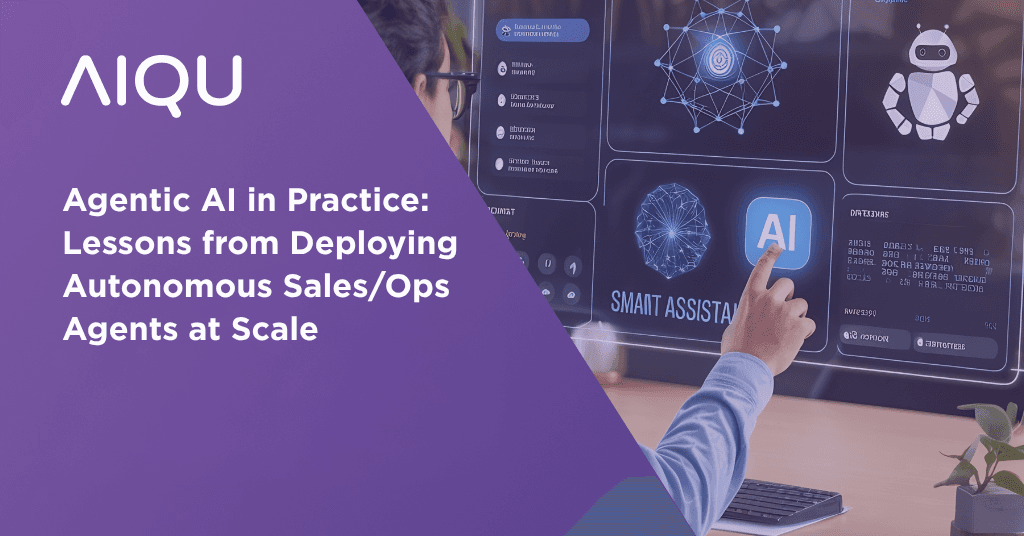
Agentic AI in Practice: Lessons from Deploying Autonomous Sales/Ops Agents at Scale
Many companies initially started with simple chatbots that handled basic customer queries. Although these systems could answer frequently asked questions, they could not perform actions or independently resolve complex issues.
The technology for enterprises is now moving in the direction of agentic AI. Rather than producing text only as output, one of the autonomous AI agents’ capabilities is decision-making, linking to the different components within a business organization and doing end-to-end tasks without the need for human interference. After introducing them into sales and operations, these agents have enabled the teams to achieve their goals in half the time and get rid of repetitive and time-consuming tasks while also dealing smoothly with their ever-increasing volume of work.
In the following paragraphs, you will find the main insights gathered by scaling up AI agents in the real-life enterprise settings.
1. What Do Autonomous AI Agents Do in Sales and Operations?
AI tools at a very low sophistication level wait for the customer to tell them what to do. Agentic AI, on the other hand, carries out the work to achieve the goal without needing human input at each stage.
AI agents can assist sales and operational teams with tasks such as the following:
- Lead Qualification and Enrichment: Lead details are cross-checked with the company databases for any background information, leads’ scores are assigned, and then the leads are directed straight to the respective business development team.
- Smart Workflow Execution: Keeping the customer relationship management system updated, making proposals, and initiating customer follow-ups based on how the client is handling his orders.
- Supply Chain and Operational Routing: The software tracks inventory, detects and alerts the team for any potential delivery delays, and automatically creates service requests.
This type of automation reduces the total amount of labor work done manually by hundreds of hours per week.
2. Hard Lessons from Deploying AI Agents at Scale
Transitioning from a small pilot run to running dozens of autonomous AI agents in daily production introduces a multitude of challenges that are very much real-life. Listed below are the lessons that we encountered as we went about it:
Establishing Clear Boundaries Is a Must
It’s important for the AI agents to have well-defined boundaries so that they operate safely. You should clearly define which actions, such as approving requests, editing records, or sending emails, the agent is authorized to perform.
For high-risk operations such as changing the prices at the wholesale level or deleting some client’s data, you should make sure that a human is involved in checking the action so that things go off on the right foot.
Data Cleanliness Ensures Avoidance of Wrong Decisions
The quality of an AI agent depends on the quality of the data it can access. When your CRM has duplicate records, is outdated, or contains messy data, then the decisions based on it won’t be good. Before you even launch the first autonomous workflow, fixing up the main data sources is one of those things you can’t go without.
API Integrations Should Be Your Focal Point, Not Just the Machine Learning Models
Even the best AI model cannot perform effectively if it cannot interact properly with your business systems. So, the ability of the AI model to reason is one aspect, but the way it is implemented is much more crucial. Your agents will be relying on a set of basic, easy-to-handle, reliable API routes from which to access your CRM, ERP, and communication systems. Well-integrated agents can perform tasks efficiently across multiple software platforms.
3. Getting Going With a Pilot Run Will Be an Easy Stepping Stone That Allows Expansion
The way to become more comfortable with AI agents inside of your company is to begin with low-risk internal workflows:
- Identify Only a Single Task: Pick an activity that involves a lot of repetition and that doesn’t require much thinking, e.g., importing new leads from the web into your sales CRM.
- Determine a Definition of Success: Be it how fast each individual operation gets completed or how accurate the machine’s decision was when it took control over the next phase, all you have to do is keep track of those straightforward performance indicators.
- Grow Gradually: Start a new agent working on one task and keep it working until it does that task without making errors.
Partner with AIQU for Enterprise AI Execution
Deploying autonomous systems is more than finding the latest gadgets. It also depends on your ability to strategize, the strength of your data resources, and your understanding of the business domain. At AIQU, we specialize in delivering cutting-edge technology that aligns AI initiatives with your company’s objectives, translating even the highest abstraction levels into actionable business outcomes through measurable results.
We support everything from solution design and architecture to implementation with experienced AI specialists. As a company with over 850 certified experts in the field of AI and machine learning, we can guarantee you a level of quality that is rarely found anywhere else.
Do you already know that there are a few hundred different ways you can use intelligent, automated workflows to increase your business efficiency but haven’t figured out the best ones for your case? If yes, then the best thing you can do is to talk to a sales professional at aiqusolutions.com today and allow us to assess what AI agents can do to help your company immediately.
Frequently Asked Questions
1. What is Agentic AI?
“Agentic AI” refers to systems that are not just smart enough to understand what is being asked or requested but also systems that would go further to understand why a particular request was made to determine if the result of the process will align with the goal of the person who asked for a change. So, it is not just about understanding a text but figuring out how to reach a goal through a series of steps and taking actions in such an order.
2. What are the fundamental differences between autonomous AI agents and conventional AI chatbots?
A chatbot can provide answers based only on information or questions given to it. On the contrary, autonomous AI agents can perform multiple tasks at once, access information from external sources, and solve tasks on their own without constant input from their human counterparts.
3. Will AI agents completely replace our sales and operations department?
Not necessarily. In this case AI agents only handle routine work, freeing up time for human employees to tackle problems of higher complexity and be creative. In other words, AI agents are meant to complement human teams and do not replace them.
4. If AI agents have access to our internal systems, will it lead to security problems?
This will only work if you grant permission to AI agents for specific systems and functions, as well as set up safeguards to prevent unauthorized use of functions and actions. Human reviewers can verify AI-generated outputs and approve only safe and appropriate actions.
5. What other types of programs besides AI agents do AI agents interact with at AIQU?
AIQU AI agents generally need to link and work with the software you already have in your company environment. This can be a combination of your CRM systems (for example, Salesforce or HubSpot), your ERP systems, your team collaboration tools like MS Teams or Slack, and the external APIs of other companies or internal DBs.